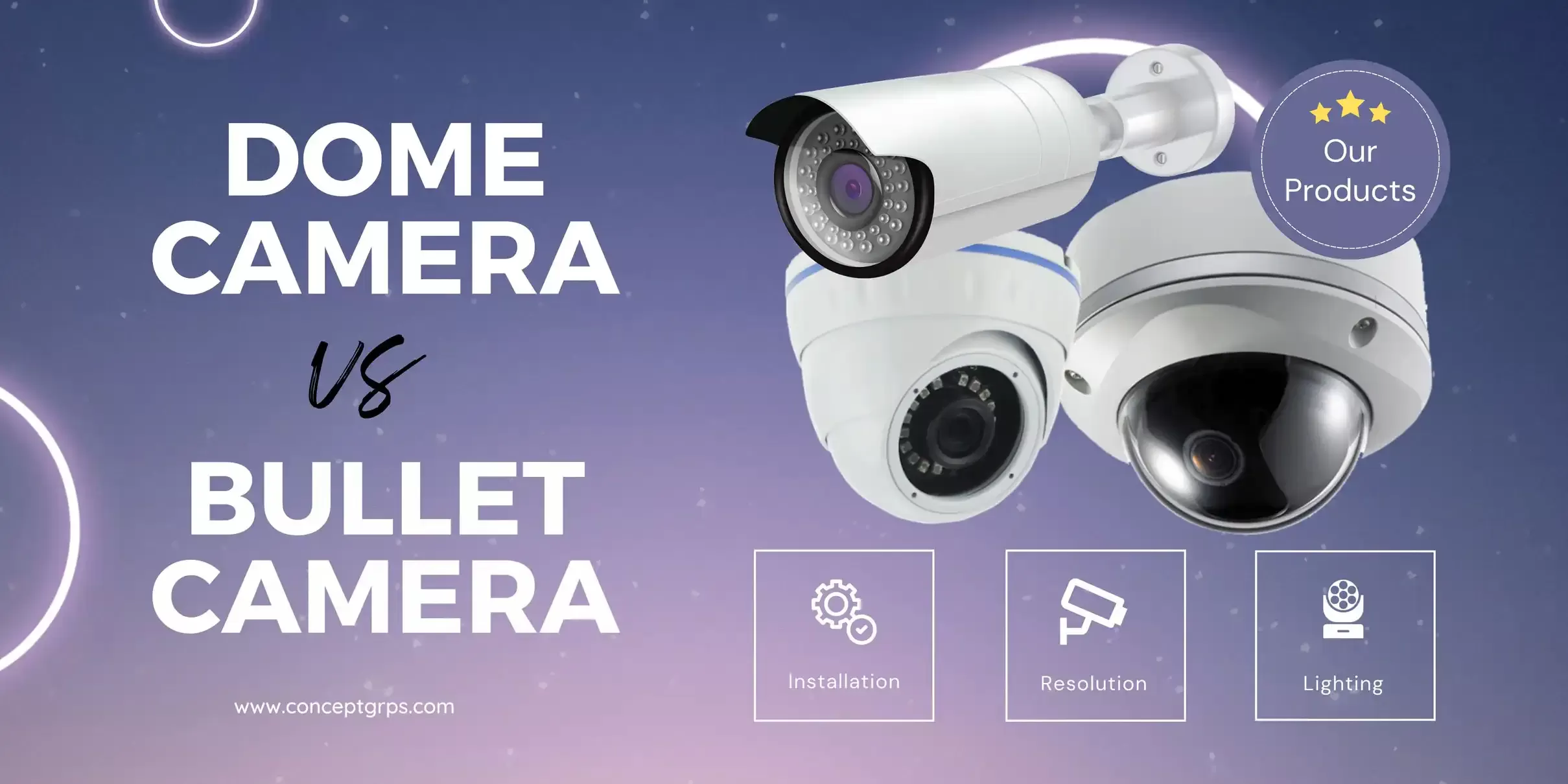
In this blog, we are seeking details about dome and bullet cameras. Closed-circuit television (CCTV) video, commonly referred to as surveillance cameras, plays a crucial role in the security strategy of any business. It is instrumental in protecting business interests, facilitating monitoring and regulation, and contributing to overall business growth. The presence of CCTVs instills a sense of safety among employees, fostering a secure and comfortable atmosphere in the workplace. By enhancing safety, CCTVs contribute to creating a pleasant and secure environment for work in any business setup.
CCTV represents a relatively recent addition to the surveillance market, designed to enhance safety and security measures. Functioning as a closed-circuit television, it is commonly referred to as video surveillance, using cameras to transmit signals to specific locations on a limited set of monitors.
Installing surveillance cameras in homes or business establishments serves as an effective method to ensure the safety and security of the premises. The well-known adage "prevention is better than cure" is highly relevant to this context. Opting for CCTV installation and prioritizing security is more advantageous than waiting for potential issues to arise and then seeking security solutions. It is undeniably more efficient to prevent a break-in rather than dealing with the consequences afterward.
In recent times, it has become commonplace to observe the widespread installation of CCTV systems in almost every building. This gadget has transitioned from being a novelty to an everyday feature in both residential and commercial settings. Whether in individual houses, apartments, schools, shops, malls, small eateries, large hotels, restaurants, bars, religious institutions, party halls, parks, jewelry stores, theaters, or on roads, the ubiquity of CCTV cameras is evident. Given the rising crime rates, maintaining constant vigilance has become imperative, making comprehensive surveillance a necessity.
Once the decision to incorporate a security system is made, the subsequent crucial step involves selecting the appropriate type or variant of camera for installation. The primary camera types under consideration are bullet cameras and dome cameras, each with subtle distinctions that merit careful consideration.
As technology continues to advance, new and distinctive features are consistently introduced. Each new feature possesses its own distinct properties and value. This holds true for both dome CCTVs and bullet CCTVs, as they represent a blend of advantages and disadvantages. The suitability of a particular feature depends on individual preferences, with one feature better meeting the needs of one person while another feature may be more suitable for someone else. Both dome CCTVs and bullet CCTVs showcase unique attributes that distinguish them, yet each has its own drawbacks. Let's swiftly examine the characteristics and distinctions between these two CCTV variants.
Dome Camera - In Brief
Dome cameras, as the name implies, derive their name from their circular, dome-shaped structure, housing the camera within a transparent protective dome. These cameras find applications both indoors and outdoors, commonly used in various businesses such as hotels, restaurants, and jewelry shops, owing to their distinctive design.
The primary advantage of dome cameras lies in their ability to obscure the direction in which the camera is pointing, thanks to the encasing dome. Furthermore, these cameras exhibit enhanced durability and resistance to vandalism since the camera lens is safeguarded. It's worth noting that some dome cameras are specifically designed to be vandal-proof, featuring robust covers resistant to tampering.
In contrast, bullet cameras are susceptible to being knocked off or manually repositioned to change their direction.
The design and configuration of dome cameras facilitate a broader monitoring angle as their lenses are adjustable, while bullet cameras have fixed lenses pointing in a single direction.
Dome cameras have a limited range compared to bullet cameras. Due to their increased susceptibility to dirt, regular cleaning schedules are essential. The installation process can be somewhat cumbersome, and repositioning dome cameras is challenging.
Dome Camera Features:
- Camouflaged to seamlessly integrate into surroundings for discreet surveillance.
- Suitable for both indoor and outdoor applications.
- Enhanced durability ensures resistance to vandalism.
- Equipped with a rotating camera providing a wide-angle view.
- Includes night vision capabilities.
- Designed to withstand various weather conditions, making it weatherproof
Bullet Camera - In Brief
Bullet cameras derive their name from their distinctive cylindrical shape, resembling a bullet shell or a lipstick tube. They are among the most prevalent types of security cameras and serve as a conspicuous deterrent. Unlike dome cameras, bullet cameras are easily noticeable and protrude, making them suitable for both indoor and outdoor installations.
While bullet cameras can be used indoors, their effectiveness as a deterrent and their extended range make them particularly well-suited for outdoor surveillance. Noteworthy features of bullet cameras include their extended range capabilities and straightforward installation. These camera variants are designed for covering expansive areas such as roads, large campuses, and parking lots. The elongated shape of bullet cameras allows for the fitting of larger lenses, making them ideal for outdoor use. The tapered tip of the bullet camera provides protection against glare and adverse weather conditions.
Bullet Camera Features:
- Effortless Installation
- Extended Coverage Range
- Weather Resistance
- Nighttime Visibility
- Versatility for Indoor and Outdoor Environments
Dome Cameras Vs. Bullet Cameras
Installation:
Dome cameras can be installed indoors or outdoors, either hanging from the ceiling or mounted on walls, providing a less conspicuous presence. However, installing dome cameras can be more involved. When adjusting the field of view is necessary, dome cameras require remounting.
Bullet cameras are versatile for both indoor and outdoor installations. They are typically wall-mounted using a mounting handle, streamlining the installation process. Bullet cameras offer easy lens positioning and repositioning without the need for remounting when adjusting the field of view.
Camera Range:
The range of the camera is influenced by factors such as the sensor chip, lens type, wide dynamic range, lines of resolution, and backlight compensation. Generally, dome cameras have smaller lenses compared to bullet cameras, as the design of bullet cameras allows for accommodating larger lenses. In essence, bullet cameras are better suited for areas requiring a camera with an extended range.
Light:
Both dome and bullet cameras are equipped with infrared LEDs to ensure adequate light availability. The infrared LEDs perform well even in low-light situations, enhancing the cameras' ability to capture clear images in various lighting conditions.
Dome and bullet cameras share many similarities, with only subtle distinctions in their features. Both types offer unique attributes, and the decision between them hinges on specific preferences and requirements. When evaluating security options, both dome and bullet cameras present viable choices, each with its own set of advantages and disadvantages.
While they share certain features, such as ease of installation and repositioning, as well as variations in their build for vandalism resistance, they differ in aspects like the range of view and aesthetic visibility. The choice between them depends on individual needs, making both types effective in different scenarios.
Critical differences include the range of view, ease of installation, resistance to vandalism due to sturdier construction, and the field of vision. Customers can tailor their decision based on the specific features required for their setup. For instance, a regular home CCTV may not necessitate an extensive range of view, whereas a farm, roads, large playgrounds, or campuses might benefit from a camera with a broader perspective.
Given the disparities between dome and bullet cameras, users have a broader array of options to choose from. Dome cameras cater to those who require a discreet setup that blends with surroundings, is resistant to vandalism, and offers a wide-angle view. On the other hand, bullet cameras are ideal for those seeking a visible deterrent, easy installation, and longer-range capabilities. Ultimately, the diverse needs of customers determine the most suitable choice.
Begin your journey with our company, where we specialize in top-notch CCTV installations, boasting a team of experts. Contact us now to secure your surroundings with our cutting-edge surveillance solutions.